Introduction
The dream of turning a picturesque piece of land into a thriving glamping retreat is more alluring than ever. For aspiring hospitality entrepreneurs, eco-conscious landowners, and career-changers, it represents a perfect blend of lifestyle and income. Yet, this dream is often stalled by formidable pain points: the staggering upfront cost of infrastructure, the maze of permits, and the critical challenge of sourcing structures that are both indestructibly durable and irresistibly Instagram-worthy.
Enter CanvasCamp. A brand that has positioned itself at the apex of the bell tent and safari tent market, promising not just a tent, but a “habitat.” But does their premium product justify the investment for a serious business venture? This in-depth CanvasCamp review will move beyond glossy marketing to provide a complete analysis. We’ll scrutinize build quality, unpack the real costs, and evaluate whether these structures can withstand the demands of commercial use and deliver the return on investment you need.
Features Overview: The CanvasCamp Proposition
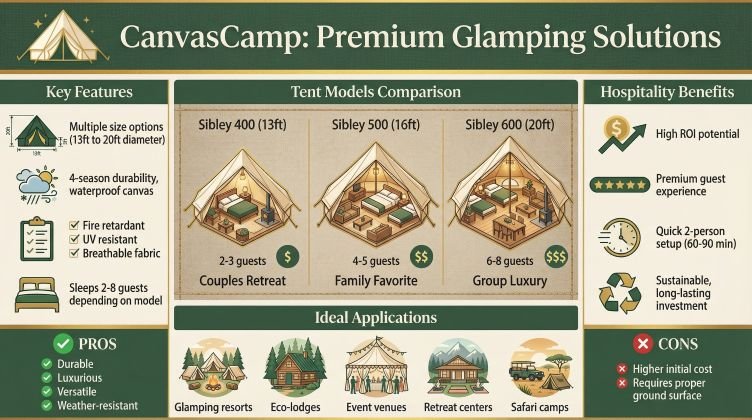
CanvasCamp specializes in high-end, heavy-duty canvas tents and hybrid structures designed for permanent or semi-permanent installation. They are a world apart from recreational camping gear.
Core Structure & Materials:
- Military-Grade Cotton Canvas: The heart of the offering. Typically, a 340gsm or heavier 100% cotton duck canvas, treated for water resistance and mildew protection. This material is breathable (reducing condensation), has excellent thermal mass (cooling in summer, retaining heat in winter), and develops a distinctive patina over time.
- Robust Frame Systems: Features engineered steel or solid hardwood frame systems, often with powder-coated finishes for corrosion resistance. Joints are reinforced, and the structures are engineered for high wind and snow loads, depending on the model.
- Commercial-Grade Components: This includes heavy-duty YKK zippers, marine-grade polyester window meshes, and professional-grade stove jack outlets designed for safe wood-burning stove installation.
Key Product Lines for Hospitality:
- Safari Tents: Their flagship for glamping. Spacious, with high ceilings, multiple windows, and often featuring attached deck platforms and modular wall systems for bathrooms.
- Bell Tents (Pro Series): The classic, elegant shape, scaled up with commercial durability. Ideal for smaller units or a more rustic aesthetic.
- Hybrid Tents & Pavilions: Large event-style structures perfect for communal areas, restaurants, or yoga studios within a retreat.
Aesthetic & Customization: This is a major selling point. CanvasCamp tents are designed with aesthetics in mind—clean lines, elegant curves, and a natural material palette. They offer significant customization: window placement, color choices for canvas and flysheets, and various add-ons like floors, partitions, and interior liners.
Performance Analysis: Durability, Weather Resistance & Commercial Viability
A beautiful tent that fails in a storm is a business-ending liability. Here’s how CanvasCamp stacks up where it counts.
Weather Resistance & Longevity:
When properly tensioned and maintained, heavy-duty cotton canvas is exceptionally weatherproof. Its breathability is its superpower in variable climates, dramatically reducing the interior condensation that plagues synthetic tents. The canvas is UV-resistant and treated to be water-repellent; with periodic reproofing (a standard requirement for any canvas), it can last 15-20 years in a permanent installation. The frames are rated for significant snow loads (often 15-20 kg/m²) and wind speeds (Beaufort 8/9+), but proper site preparation and professional installation are non-negotiable to achieve these ratings.
Beyond durability, operational concerns like ease of assembly and ongoing maintenance can be make-or-break factors for hospitality operations.
- Assembly: These are not “pop-up” tents. Initial setup is a 2-3 person job and can take a full day or more for larger safari tents. CanvasCamp provides comprehensive manuals, and many business owners hire local contractors or the company’s own installation teams. <Explore CanvasCamp’s professional installation services here> to understand the costs and logistics.
- Maintenance: Commercial use demands a regimen. This includes seasonal cleaning, re-tensioning after wet/dry cycles, and reproofing the canvas every 2-3 years. Failure to maintain voids warranties and shortens the lifespan.
Customer Support & Warranty:
CanvasCamp offers a standard 2-year warranty on materials and workmanship, which is industry-standard but can feel limited for a capital investment. The warranty does not cover damage from failure to maintain, improper installation, or normal “wear and tear” resulting from commercial use. Support is generally reported as knowledgeable but can be slower during peak seasons. For commercial clients, clarifying support response times and the availability of spare parts (e.g., a replacement pole section or zipper) is a crucial pre-purchase step.
Pros and Cons: The Unvarnished Truth
Pros:
- Unmatched Aesthetic & Guest Appeal: Creates the “wow” factor essential for premium pricing in glamping.
- Superior Material Quality: The breathable cotton canvas provides a guest comfort advantage over synthetic alternatives in most climates.
- Commercial-Grade Durability: When maintained, these structures are built to handle back-to-back guest turnovers and harsh weather.
- Strong Customization: Allows you to tailor the structure to your specific land and business model.
- Strong Resale Value: Well-maintained CanvasCamp tents hold their value remarkably well on the secondary market.
Cons:
- Very High Initial Investment: A fully equipped Safari Tent ready for guests can easily cost $15,000-$25,000+ before site work.
- Complex & Costly Installation: Requires skilled labor, proper foundations (deck/platform), and potentially engineering sign-off for permits.
- Ongoing Maintenance Requirement: Passive income is not maintenance-free. The canvas requires active care.
- Lead Times: Custom orders can take 8-16 weeks, which must be factored into business planning.
- Warranty Limitations: The 2-year warranty excludes normal wear and tear from commercial use, owner neglect, and installation errors. Owners are responsible for regular maintenance to keep the warranty valid.
User Experience: From Unboxing to Guest Reviews
The Owner/Operator Experience:
The journey begins with a substantial delivery—crates of heavy canvas, steel, and hardware. The initial setup is daunting but transformative. Owners frequently describe a sense of awe once the structure is up. The daily operational experience is positive; the tents feel solid and secure. The maintenance, while required, becomes a seasonal ritual. The biggest operational headaches typically relate not to the tent itself, but to integrating utilities (power, water, septic) seamlessly into the structure.
The Guest Experience (The Ultimate Test):
This is where CanvasCamp theoretically earns its keep. Guests consistently rave about the ambiance. The breathable canvas creates a unique, quiet, and odor-neutral environment that feels connected to nature without being damp or clammy. The aesthetic provides a perfect backdrop for the “experience” guests are paying for. The perception of quality—from the heavy zippers to the stout poles—justifies a premium nightly rate and fuels positive reviews and repeat bookings.
Value for Money: Calculating Your ROI
This is the most critical section for our target audience. Is CanvasCamp a cost or an investment?
Breaking Down the True Cost:
- Base Tent Price: $5,000 – $20,000+
- Essential Add-ons: Flooring kit, insulation liner, stove jack, partitions. (+$1,500 – $5,000)
- Professional Installation & Foundation: A leveled deck or platform is mandatory. (+$3,000 – $10,000+)
- Utility Integration: Running power, lighting, and plumbing. (Variable, often $2,000 – $8,000)
- Interior Furnishings: To commercial standard. ($5,000 – $15,000+)
Total Realistic Startup Cost per Unit: $15,000 – $50,000+
The ROI Equation:
To justify this, you must run the numbers for your market.
- Example: A $30,000 safari tent suite in a high-demand glamping area.
- Assume: A $250/night rate, 60% occupancy over a 6-month season (110 nights).
- Annual Revenue: $27,500.
- After operational costs (cleaning, maintenance, marketing, utilities, management), a well-run unit could see a 40-50% profit margin, yielding ~$11,000 – $13,750 annually.
- Payback Period: ~2.5 – 3 years, excluding land costs. This is a credible ROI for a lifestyle business asset with a 15+ year lifespan.
The Alternative Cost: Compare this to building a permanent cabin, which can easily cost $75,000-$150,000+, with longer permit timelines and greater environmental impact. The tent often wins on speed to market and lower regulatory hurdles.
Ready to model your own numbers? to get accurate figures for your business plan.
Final Verdict: Who Should (and Shouldn’t) Invest in CanvasCamp?
CanvasCamp is a STRONG, JUSTIFIED INVESTMENT for:
- The Serious Glamping Entrepreneur: You have a business plan, understand your market, and need a durable, guest-pleasing asset to execute it. The quality supports premium pricing.
- The Eco-Conscious Landowner: You want minimal site impact, natural materials, and a structure that feels harmonious with the landscape. The breathable canvas is a key ecological benefit.
- The Hospitality Professional: You understand operational maintenance and value a supplier with a strong brand reputation that enhances your own.
CanvasCamp is a POOR FIT for:
- The Completely Passive Income Seeker: If you want zero hands-on involvement, the maintenance requirements will be a burden. Consider a turn-key pod or tiny home instead.
- The Ultra-Tight Budget Startup: If your capital is extremely limited, a used RV or a more basic tent brand may be a necessary first step.
- Those in Extremely Harsh, Consistent Wet Climates: While weatherproof, constant heavy rain and humidity demand exceptional site drainage and vigilant maintenance, a synthetic, fully sealed structure might be more suitable.
The Bottom Line of This CanvasCamp Review:
CanvasCamp is not selling tents; they are selling the foundational asset for a premium outdoor hospitality experience. The quality is tangible, the aesthetic is a powerful marketing tool, and the durability, when paired with responsible stewardship, provides a long-term return.
For the right entrepreneur—one who views this as a hands-on, meaningful venture and not a get-rich-quick scheme—a CanvasCamp structure is a formidable tool that can turn a parcel of land into a profitable and enchanting destination. It requires respect, investment, and care, but in return, it offers the authentic, high-quality foundation upon which successful glamping dreams are built.