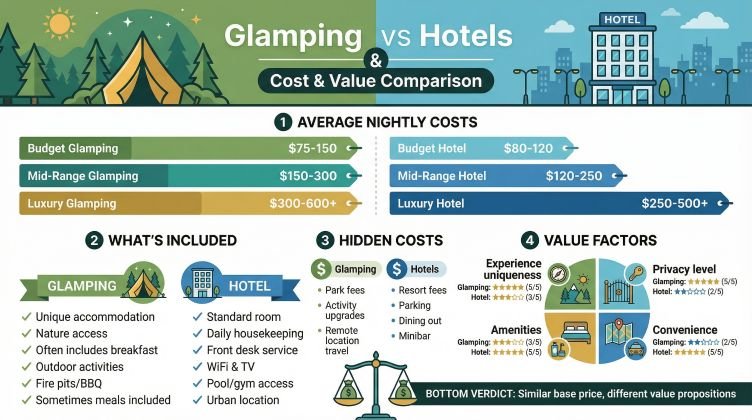
Meta Description: Glamping vs. hotels: Which is cheaper? We break down costs, value, and when each is the better choice for luxury travelers. Get the full answer here.
Quick Answer (TL;DR)
The true answer: glamping often delivers more value for luxury family and group travelers, while hotels offer better last-minute or solo deals. Comparing just nightly rates misses the bigger picture. Glamping is about experience and immersion; hotels focus on predictability and amenities. For groups, book glamping early in the shoulder season for the best value. Hotels excel when urban convenience is key. Your decision depends on whether you want reliable comfort or a unique adventure.
Understanding the Question: It’s More Than Just a Nightly Rate
The key question isn’t simply which costs less, but which offers better value for the experience you seek. Glamping is a curated, often more immersive escape centered around novelty and nature. Hotels trade on convenience and standards. Deciding between them means weighing a unique adventure against familiar comfort.
The core of the question touches on three deeper concerns for our target audience:
- Budget Value: “Am I getting my money’s worth for this unique vacation?”
- Experience Clarity: “What am I actually paying for—just a bed, or something more?”
- Trip Planning: “How do I allocate my budget for the best overall getaway?”
Look beyond sticker price—consider location, what’s included, group size, and the added cost for the experience.
Detailed Explanation: The Cost Breakdown
Let’s dissect the financials of both options to see where the money goes.
Glamping Cost Components
- The Nightly Rate: This covers the unique accommodation (tent, dome, treehouse) and its maintenance on often expensive, remote land.
- The Experience Premium: You’re paying for the novelty, design, and the “Instagrammable” factor of a one-of-a-kind stay.
- Bundled Activities/Amenities: Many glamping stays include perks like firewood, breakfast baskets, on-site hiking trails, or kayaks, which add value.
- Location Surcharge: Seclusion has a price. Remote sites may require 4WD or longer travel, but you’re paying for privacy and untouched views.
- Potential Add-ons: Things like private chef dinners, guided tours, or spa treatments are usually extra.
Hotel Cost Components
- The Nightly Rate: Covers the room, utilities, and access to common areas in a high-traffic, convenient location.
- Service & Staffing: A significant portion of the cost covers 24/7 front desk, concierge, cleaning, and maintenance teams.
- Amenity Access: You may have access to a pool, gym, business center, and daily housekeeping.
- Resort & Destination Fees: These hidden costs, now common at luxury hotels, can add $40-$100+ per night for “amenities” you may not use.
- Incidentals: Parking, minibar, room service, and on-site restaurants dramatically inflate the final bill.
The Value Verdict by Traveler Type
- Luxury Families: Glamping often wins on value. A single, large safari tent or cabin that sleeps a family of four is often cheaper than two connecting luxury hotel rooms. The on-site space for kids to explore is a free bonus.
- Romantic Couples: Prices are often similar. Choose between boutique hotel amenities or a secluded glamping stay for a unique experience.
- Empty Nesters: Value depends on your preference—choose hotels for luxury and dining or glamping for peace and nature immersion.
- Solo Travelers & Last-Minute: Hotels win, with single rates and last-minute deals. Glamping charges per unit and books out early.
Key Points to Remember When Comparing
- The Group Size Multiplier: This is the most decisive factor. Hotel costs multiply per room. Glamping costs are often per unit.
- Food: Glamping with a kitchenette can save you money on meals, while hotel stays often mean eating out.
- Entertainment: Glamping offers built-in fun, while hotels may require extra entertainment spending.
- Seasonality: Glamping prices fluctuate more with the seasons than hotels do, which may even be cheaper on weekends.
- Always tally the final cost. For hotels, add fees, parking, and meals. For glamping, include travel costs and premium activities.
Examples and Case Studies
Case Study 1: A Family of Four, Summer Week in California
- Luxury Hotel (Coastal Resort): 2x connecting ocean-view rooms @ $450/night = $3,150 for 7 nights. Add resort fees ($35/night), parking ($50/night), and estimated meals out ($300/day) = Total: ~$7,315.
- Glamping (Safari Tent in Big Sur): One large tent with a king bed + bunk nook @ $575/night = $4,025 for 7 nights. Includes breakfast basket and firewood. Add the cost of groceries for meals cooked on the grill/kitchenette ($150 total) and fuel. Total: ~$4,300.
- Verdict: Glamping offers a savings of over $3,000 and a more immersive family experience.
Case Study 2: A Couple, Romantic Weekend in the Rockies
- Boutique Hotel (Ski Town): King suite with fireplace @ $425/night = $850 for 2 nights. Add destination fee ($40/night), valet parking, and two nice dinners ($300).
- Glamping (Geodesic Dome with Hot Tub): Dome with mountain view @ $395/night = $790 for 2 nights. Includes a full kitchen and a private hot tub. Add the cost of groceries and a splurge dinner out one night ($150).
- Verdict: Costs are very comparable (~$1,300 range). The choice is purely experiential: alpine village charm vs. private, secluded intimacy.
Expert Insights: Maximizing Your Budget
We spoke with veteran travel planners and glamping site owners for their top tips:
- “Think Per-Person, Not Per-Night.” – Sarah K., Luxury Travel Advisor. “For groups, always divide the total accommodation cost by the number of guests. Glamping units shine in this math. A $600/night treehouse for four is $150/person, which is hard to beat in a luxury market.”
- “The Sweet Spot is Shoulder Season.” – Mark T., Glamping Site Owner (Colorado). “The three weeks after peak season are our secret. The weather is still fantastic, rates can drop 25-40%, and you get the same incredible experience without the crowd premium. This is when glamming can drastically undercut resort pricing.”
- “Your Gear Can Unlock Affordable Adventures.” – The Adventure Couple Blog. “If you fall in love with the glamping lifestyle, investing in a few key pieces of high-quality gear—like a premium bell tent and a comfortable camp bed—allows you to create ‘pop-up glamping’ experiences at standard campgrounds for a fraction of the cost.” Check out our guide to essential glamping gear for beginners.
- “Use Specialized Search Platforms.” – The Glamping Guru. “Don’t just scour standard travel sites. Platforms like Glamping Hub are tailored to filter these unique stays and often list properties you won’t find elsewhere, allowing for better comparison.” Start your search for unique glamping stays here.
Additional Resources
To help you plan and potentially save, consider these tools:
- Cost Calculator Template: Download our simple spreadsheet to input your variables (group size, nights, meal budget) and directly compare a shortlisted glamping stay against a hotel.
- Seasonality Guides: Research the “shoulder seasons” for your desired destination to identify the best time for value.
- Packing Lists: Being prepared prevents expensive last-minute purchases at remote general stores. A well-packed portable espresso maker or quality cooler can elevate your stay without breaking the bank. Download our printable luxury glamping packing checklist here.
Conclusion: The Final Verdict on Value
So, is glamping cheaper than hotels? Glamping often offers better value—particularly for groups and those seeking a deep experience—while hotels remain the go-to for last-minute or solo luxury. The best choice depends on what matters most to you: cost-effective adventure or predictable convenience.
Choose a hotel if your priority is: ultimate convenience, consistent luxury service, urban exploration, last-minute travel, or you’re traveling solo.
Choose glamping if your priority is: a unique, memorable experience, a deep connection with nature, cost-effective travel for a family or group, privacy, and the adventure of a more secluded retreat.
Your budget isn’t just for buying a bed for the night. It’s funding the memories you’ll create. For many luxury travelers today, the unparalleled experience of waking up in a beautiful landscape, with comfort intact, is worth every penny—and sometimes, it even saves a few.
Frequently Asked Questions
Q: Can glamping be considered “luxury”? A: Yes. Choose sites with excellent reviews and fewer frills, such as a yurt with a shared bathhouse. Enhance your stay by bringing your own upscale amenities—like fine linens, gourmet food, and wine. The natural setting provides the main experience. more magic.
Q: Are glamping accommodations safe and secure?
A: Reputable glamping sites prioritize safety with secure locks, fire safety equipment, and clear protocols. Always read safety reviews, especially for remote locations.
Q: What if I don’t like camping? Will I enjoy A: Most likely. If your concerns about camping are discomfort, lack of cleanliness, or a lack of climate control, glamping addresses those issues. Glamping is well-suited to those who want to enjoy nature while having a comfortable bed and a pleasant environment. full space.
Q: How far in advance should I book glamping vs. a hotel?
A: For popular glamping destinations, book 4-9 months in advance for peak season. For hotels, 2-4 months is often sufficient, though last-minute deals can be found.
Q: What is the single biggest hidden cost in glamping?
A: Travel logistics. The cost and time to reach a remote location, which may require an upgrade to a rental car, are the most commonly underestimated factors. Always map the precise route from a major airport.